FBA Prep: What It Is, Amazon's Rules and Who Does It Now
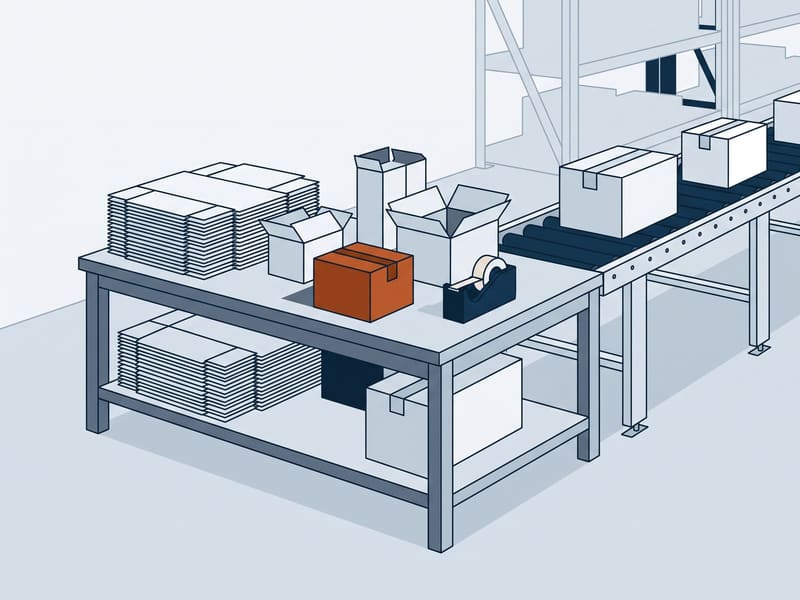
FBA prep is the work of getting units and cartons ready for an Amazon fulfillment center: bagging, bubble wrap, set labels, barcodes and carton labels, all to Amazon's packaging rules. Since January 1, 2026, Amazon no longer does any of it for US sellers. We cover the rules by product type, the labels, the carton limits, who can do the work and what it costs.
Quick summary
- FBA prep means packaging, labeling and boxing each unit and carton to Amazon's requirements before a shipment reaches a fulfillment center.
- Amazon stopped offering prep and item labeling for US FBA shipments on January 1, 2026, and units that arrive without proper prep are not eligible for reimbursement if damaged or untraceable.
- Poly bags must be at least 1.5 mil thick and carry a suffocation warning when the opening is 5 inches or more, and sets need a label saying they are sold together.
- Since March 31, 2026, brand owners can keep using manufacturer barcodes, while resellers must label every unit with an Amazon FNSKU barcode.
- Prep can be done in house, by a 3PL or prep center, or at the factory; our 1,200-unit example costs $0.77 to $1.51 a unit through an outside provider.
What FBA prep is
FBA prep covers everything that happens to your products between the factory and an Amazon fulfillment center’s receiving dock. Some of the work is per unit, some per carton:
- Per unit: inspect and count, bag or bubble wrap where required, bundle and label sets, apply a barcode label, add expiration dates.
- Per carton: cover old barcodes, pack to Amazon’s size and weight limits, weigh and measure, apply an FBA Box ID label to each box.
The rules come from Amazon’s product packaging requirements, and a unit that falls under more than one category has to meet every one that applies. A set of shampoo and conditioner, for example, needs the liquids prep and a set label.
Amazon stopped prepping for US sellers on January 1, 2026
Amazon used to prep and label units that arrived without it, for a fee. It ended that service for US FBA shipments on January 1, 2026, covering inventory sent straight to FBA and inventory that reaches FBA through Amazon Warehousing and Distribution, Amazon Global Logistics, Amazon SEND and Supply Chain Portal. Shipments created after that date that arrive without proper prep and labeling are not eligible for reimbursement if damaged or untraceable.
The packaging rules add the rest. Amazon may refuse, return or repackage non-compliant units at your expense, and it can add prep requirements to a product after damage-related returns. The safety net is gone, so prep has to be right before the truck leaves.
Amazon’s prep rules by product type
| Product type | Required prep | Detail |
|---|---|---|
| Fragile or glass | Bubble wrap; over-box if it fails a 3-foot drop test | Boxed units over 10 lb need double-wall corrugated |
| Apparel, fabric, plush, textiles | Poly bag | Normal hangers removed |
| Small items, longest side under 2 inches | Poly bag | Keeps them findable |
| Powders, pellets, granular products | Poly bag | If they spill when shaken |
| Liquids | Cap seal on spray bottles; bag hazmat liquids | Hazmat liquids in glass over 4.2 oz also need over-boxing |
| Sets and multi-packs | Sealed together, labeled as a set | “Sold as set” or “This is a set. Do not separate.” |
| Sharp items | Cut- and puncture-resistant packaging | Bubble wrap does not count |
| Adult products | Opaque bag or shrink wrap | Barcode on the outside |
| Expiration-dated products | Date on each unit and on the outer box | MM-DD-YYYY or MM-YYYY, 36-point on the box |
| Loose multi-piece items | One secure package | Nothing Amazon would have to assemble |
Two more rules catch sellers who ship from a retail setup: no pre-priced labels, price tags or marketing flyers, and no theft-prevention devices on the product. Perishables are not accepted at all.
Poly bag rules
Amazon’s bagging requirements are specific. The bag must be at least 1.5 mil thick, fully enclose the item, be sealed with tape or an adhesive strip, and extend no more than 3 inches past the product. It must be clear enough for the barcode to scan through, or carry the barcode on the outside. Any bag with an opening of 5 inches or more, measured flat, needs a printed or labeled suffocation warning in Amazon’s exact wording, at 10 to 24 point depending on the bag’s size.
Unit labels and barcodes
Every unit needs one exterior barcode that Amazon can scan: either the manufacturer barcode (UPC, EAN, JAN or ISBN) or an Amazon FNSKU label, which starts with an X. Amazon’s barcode requirements changed on March 31, 2026: brand owners can keep using manufacturer barcodes without stickers, while resellers must use Amazon barcodes even when a manufacturer barcode exists.
Each FNSKU must map to one product, so every size, color and condition gets its own. Labels go on a flat face, never on a corner or curve. Old barcodes on the outside of shipping boxes must be removed, covered with opaque tape or blacked out, so receiving scans the right one.
Carton rules for shipments into Amazon
Amazon’s shipping and routing requirements cap standard boxes at 36 by 25 by 25 inches and 50 lb, unless a box holds a single oversize item, which then needs Team Lift labels. Every box needs its own FBA Box ID label, and each pallet needs 4 pallet labels, one per side. Pack with 2 inches of cushioning, and never use pallet-sized gaylord boxes.
Case packs from the manufacturer get lighter treatment: one SKU and condition per box, the same quantity in every box, and no more than 150 units per case.
The FBA prep process, step by step
- Receive and count the inbound against the purchase order or ship notice, and log shortages and damage.
- Inspect a sample of units for defects and packaging damage before any labor goes into them.
- Prep each unit to its category: bag, wrap, seal or bundle.
- Label each unit with its barcode and add expiration dates where needed.
- Pack cartons within the size and weight limits, one SKU per box where you can.
- Label cartons with FBA Box ID labels and cover any old barcodes.
- Ship or hold: send the shipment to its assigned fulfillment center, or hold prepped stock and release it in smaller shipments.
Who should do the prep
| Route | Fits when | Watch for |
|---|---|---|
| In house | Small catalog, steady volume, simple products, spare space | Labor at peak; one untrained temp can fail a whole shipment |
| 3PL or prep center | Volume swings, bagged or fragile products, stock already at a 3PL | Who pays when a shipment is refused for their error |
| Factory | Manufacturer can follow a written spec, large repeat runs | An error arrives a container at a time |
A 3PL that already runs your DTC or wholesale orders is the natural candidate, because the stock is already in its building. The prep questions belong in the same RFP you use when choosing a 3PL: error rate per unit and how it is measured, which barcode they apply by default, turnaround from receipt to shipment, and who books freight into Amazon.
What FBA prep costs
Prep is billed like any other 3PL fee: per unit for labels, bags and wrap, per carton for packing and box labels, and sometimes per hour for rework. For reference, Amazon’s own fees before it stopped were $0.55 a unit for labeling, $0.70 for bagging and $1.04 for bubble wrap on a standard-size item.
Running FBA prep and DTC from one 3PL
Many brands keep one inventory pool at a 3PL and send Amazon only what it needs. The 3PL ships DTC and wholesale orders from the pool, preps a slice for FBA each week or two, and holds the rest. This drip-feed keeps less stock in FBA, where Amazon bills storage on cubic feet and adds a surcharge past 181 days, and it means one count of your inventory instead of two.
The 3PL’s WMS has to keep the two apart: units labeled with an FNSKU are committed to Amazon and should not be picked for a DTC order, while unlabeled stock stays available for every channel.
Frequently asked questions
What does FBA prep mean?
FBA prep is preparing products to Amazon's packaging and labeling rules before sending them to a fulfillment center. It covers bagging, bubble wrap, set labels, barcode labels, boxing and carton labels. The seller is responsible for it, either directly or through a service provider.
Is Amazon FBA prep ending?
Amazon's own prep and item labeling service ended for US FBA shipments on January 1, 2026. The prep requirements did not end: every unit still has to arrive prepped and labeled. The work now falls to the seller, a prep provider or the manufacturer.
Does Amazon prep items for you?
Not in the US any more. Shipments created before January 1, 2026 kept the service even if they arrived later, but shipments created after that date must arrive prepped. Amazon points sellers to doing it themselves or to third-party prep providers.
How much does FBA prep cost?
In our example, prepping a 1,200-unit shipment of 3 SKUs through an outside provider costs $0.77 to $1.51 a unit, depending on how many units need bags or bubble wrap. For reference, Amazon charged $0.55 a unit for labeling and $0.70 for bagging a standard-size item before it stopped. Freight into Amazon is extra.
Should I prep in-house or use a prep center?
Prep in house when the catalog is small, volume is steady and you have space and staff. Use a 3PL or prep center when volume swings, when products need bags or wrap, or when stock already sits in a 3PL for other channels. Factory prep is cheapest when the manufacturer can hold the spec.
Can my manufacturer do FBA prep?
Yes, if it can meet Amazon's rules consistently. Send the exact bag, label and carton spec, ask for photos of the first production run, and inspect the first shipment before it goes to Amazon. A mistake at the factory repeats across a whole container.
What happens if a shipment arrives without the right prep?
Amazon may refuse, return or repackage the units at your expense, and non-compliant inventory is not eligible for reimbursement if it is damaged or lost. Amazon can also add prep requirements to a product after damage-related returns, and missed bagging can bring a preparation defect fee.
Do I need to cover the manufacturer barcode?
On shipping boxes, yes: Amazon requires existing barcodes on the outside of boxes to be removed, covered or made unscannable. On units, it depends on your barcode setting, since brand owners can track by the manufacturer barcode while resellers must apply an FNSKU label. When you apply an FNSKU, place it so it is the only barcode a scanner can read.
What is drip-feeding inventory into FBA?
Drip-feeding means holding bulk stock at a 3PL or prep center and sending it to Amazon in smaller, regular shipments. It keeps less inventory in FBA, where storage is billed on daily average cubic feet and a surcharge applies to stock held past 181 days. The trade-off is more inbound shipments to book and prep.