What Is a Fulfillment Center? How It Works and Who Needs One
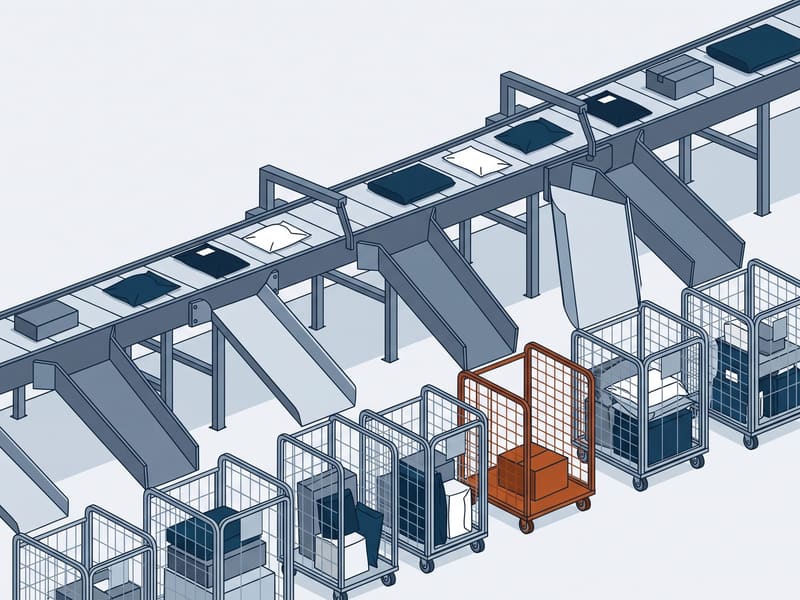
A fulfillment center is a warehouse built to ship orders rather than hold stock. Inventory arrives in bulk, sits on shelves for days or weeks, and leaves as individual parcels, often within hours of the order. We follow one order through a fulfillment center hour by hour, compare the building with a warehouse and a distribution center, and set out when a brand should use a 3PL's fulfillment center, Amazon's, or its own.
Quick summary
- A fulfillment center is a building where a seller's inventory is received, stored, picked, packed and shipped to customers, usually run by a 3PL for many brands at once.
- Stock turns over in days or weeks rather than months, and carriers collect at least once a day, so an order placed before the cutoff normally ships the same day.
- A warehouse is built for holding stock and a distribution center for bulk moves to stores, while a fulfillment center is built for many small consumer orders.
- Amazon's FBA network bills storage monthly by average cubic feet, adds an aged-inventory charge on items held more than 181 days, and serves Amazon orders first.
- The cost of using someone else's fulfillment center is control, so the SLA, the integration and the reports have to show you what you used to see on your own floor.
What a fulfillment center is
A fulfillment center is a warehouse laid out for outbound speed. Its job is to turn online orders into packed, labeled parcels on a carrier’s truck, most of them the day the order arrives.
Most fulfillment centers are run by a third-party logistics provider for many brands at once. The Bureau of Labor Statistics files those buildings in warehousing and storage (NAICS 493), an industry of businesses that store goods they do not sell and add services such as order fulfillment, packaging and pick and pack. That industry employed 457,740 stock clerks and order fillers in 2025, at a median $21.49 an hour; they are the people walking the aisles in a fulfillment center.
There are 3 kinds of operator:
- 3PL fulfillment centers: multi-client buildings where brands share space, staff and carrier pickups and pay per order.
- Marketplace networks: Amazon’s fulfillment centers under Fulfillment by Amazon (FBA), which Amazon says number in the hundreds worldwide.
- A brand’s own: a building it leases, staffs and runs for its own orders.
How a fulfillment center works
Stock arrives in bulk, on pallets or in cartons, against an advance ship notice. Receivers count and scan it, and the warehouse management system (WMS) assigns each SKU a location. Fast sellers go nearest the pack stations; slow ones go high or far back. That placement, called slotting, is what keeps walking time down.
Orders flow in from the store or marketplace through an integration and wait in the WMS until they are released to the floor. How they are picked depends on volume and order shape:
| Picking method | How it works | Suits |
|---|---|---|
| Single-order | 1 picker, 1 order, start to finish | Low volume, large items |
| Batch | 1 picker collects items for several orders in one trip | Many small orders with overlapping SKUs |
| Wave | Orders released in timed groups, usually matched to carrier pickups | High volume with fixed cutoffs |
| Zone | Each picker covers one area; orders pass between zones | Large buildings, many SKUs |
At the pack station, each item is scanned against the order before it goes in the box. That scan is what order accuracy rests on: the share of orders shipped with the right items in the right quantities. The WMS then compares carrier rates, prints the label, sends tracking back to the store and routes the parcel by conveyor or cart to the carrier’s outbound lane.
Returns run the same path backward: received, inspected, and either restocked or set aside under the brand’s rules.
One order’s day in a fulfillment center
Take a 2-item skincare order placed on a brand’s website. The 3PL’s order cutoff is 1:00 p.m. and the last carrier trailer leaves at 3:00 p.m.
| Time | What happens |
|---|---|
| 9:42 a.m. | Customer checks out; the store sends the order to the 3PL’s WMS within minutes |
| 10:00 a.m. | The WMS adds it to a wave of 300 orders due on the 3:00 p.m. trailer |
| 10:25 a.m. | A picker collects both items in a batch pick with 11 other orders |
| 11:10 a.m. | A packer scans both items, packs the specified mailer and adds the insert card |
| 11:14 a.m. | The label prints; tracking posts back to the store and the customer’s confirmation email |
| 11:20 a.m. | The parcel rides the conveyor to the carrier’s staging lane |
| 3:00 p.m. | The carrier’s trailer leaves with the order on it |
A second customer who orders at 1:20 p.m. misses the cutoff. The order still gets picked that afternoon if the floor has capacity, but it waits for the next day’s trailer. The cutoff is set by how long the floor needs between the last order and the trailer, not by when the trailer arrives.
Fulfillment center vs warehouse vs distribution center
| Fulfillment center | Warehouse | Distribution center | |
|---|---|---|---|
| Built for | Many small orders to consumers | Holding stock | Bulk moves to stores and businesses |
| Typical dwell time | Days to weeks | Weeks to years | Hours to days |
| Outbound unit | Parcels of 1 to a few items | Pallets, when the stock is needed | Pallets and cases on scheduled trucks |
| Carrier pickups | At least daily | As needed | Scheduled routes |
| Main measure | Ship time and order accuracy | Cost per pallet stored | On-time, in-full delivery |
| Typical client | DTC and marketplace sellers | Manufacturers, importers, seasonal stock | Retailers and wholesale suppliers |
In practice the lines blur. A single 3PL building often holds bulk pallets in its racking and feeds a fulfillment floor from them, which is why 3PL warehousing and parcel fulfillment are frequently sold on one rate card. The table still matters when you compare providers: a building designed around pallets to retailers will struggle with 5,000 parcels a day, and the reverse.
Value-added services
Most fulfillment centers sell work beyond the pick, pack and ship, billed per unit or by the hour:
- Kitting and bundling: assembling several SKUs into a new one, such as a gift set.
- Custom packaging: branded boxes, tissue, tape and printed inserts.
- Labeling: barcodes, retailer compliance labels, lot and expiry labels.
- Light assembly and inspection: attaching parts, testing electronics, quality checks on arrival.
- Returns processing: grading, repackaging and restocking.
Each of these runs on written instructions, and a packer working through hundreds of orders a shift follows the instruction on the screen, not the intent behind it.
3PL fulfillment center vs Amazon FBA vs your own
Where the inventory sits decides what you can control. Amazon’s published FBA terms set the middle column: fulfillment fees based on the product’s price, weight and dimensions, and storage charged monthly by daily average cubic feet, with an aged-inventory charge on items held more than 181 days.
| 3PL fulfillment center | Amazon FBA | Your own | |
|---|---|---|---|
| Channels served | Every channel you connect: store, marketplaces, wholesale | Amazon orders; Amazon’s bulk tier also supplies other channels | Anything you choose |
| Storage billing | Per pallet, shelf or bin, monthly | Monthly by average cubic feet, plus a charge past 181 days | Your rent, full or empty |
| Fulfillment fees | Per order and per item, on a rate card | Per unit, by price, weight and dimensions | Your labor and materials |
| Customer service and returns | You answer customers; the 3PL processes returns | Amazon handles both for Amazon orders | You handle both |
| Packaging and inserts | Your spec and branding | Set by Amazon | Anything you choose |
| What you control | Whatever the contract and SLA say | What Amazon’s policies allow | Everything |
Many brands use 2 of the 3: FBA for Amazon orders and a 3PL for their own site and wholesale, with the 3PL’s bulk storage feeding FBA as stock sells. Each extra operation adds another inventory count to reconcile, and brands running several providers across regions sometimes hire a 4PL to coordinate them.
Why brands use a fulfillment center, and what goes wrong
The gains:
- Speed. Daily pickups and same-day shipping for orders before the cutoff.
- Carrier rates. Postage negotiated on the volume of every brand in the building.
- Capacity on demand. Peak season staffing is the operator’s problem, not yours.
- No fixed overhead. No lease, racking, conveyors or WMS to buy.
- More than one location. Splitting stock between 2 or 3 buildings shortens the ground trip to most customers.
A brand that can afford only one building usually looks at the middle of the country: the Dallas-Fort Worth warehouse market, for example, puts more of the US within a short ground transit than a building on either coast.
The risks are the other side of the same arrangement. You lose direct sight of the floor, so a mis-pick surfaces as a customer complaint rather than something you catch. Service varies between buildings and between the accounts inside them. And every promise you make to customers now depends on someone else’s schedule.
When a brand needs a fulfillment center
A brand needs one when packing orders has become a job rather than a task: when orders arrive every day, when customers expect delivery in 2 to 5 days, when a garage or back room no longer holds the stock, or when it sells on more than one channel and needs one inventory pool behind all of them. A brand shipping mostly pallets to retailers needs a warehouse or distribution center instead.
Whichever building you choose, the first weeks go more smoothly when the data arrives before the stock does.
Frequently asked questions
What is the difference between a warehouse and a fulfillment center?
A warehouse is built to store goods, often for months, and ships them out in bulk when needed. A fulfillment center is built to ship individual customer orders quickly, holds stock for days or weeks, and has carriers collecting at least once a day. Many 3PL buildings run both functions under one roof.
What is an example of a fulfillment center?
The most common example is a 3PL's multi-client building, where dozens of brands share space, staff and carrier pickups. Marketplace networks such as Amazon's are another, holding sellers' stock for orders placed on the marketplace. Larger brands also run their own fulfillment centers for their own orders.
What is a fulfillment center in Amazon?
It is one of the buildings where Amazon stores sellers' inventory and ships Amazon orders under Fulfillment by Amazon. Amazon says its network includes hundreds of fulfillment centers worldwide, and it picks, packs, ships and handles customer service and returns for those orders. Sellers pay fulfillment fees per unit plus monthly storage.
Can I shop at an Amazon fulfillment center?
No. A fulfillment center is a closed industrial building with no store or pickup counter for shoppers. Orders are placed online and leave by carrier.
How long does inventory stay in a fulfillment center?
Ideally a few weeks at most, since the building is set up for turnover rather than storage. Stock that sits much longer usually costs more: Amazon, for example, adds a monthly aged-inventory charge on items held more than 181 days, and many 3PLs charge a higher long-term storage rate. Slow sellers are often better kept in cheaper bulk storage and fed in as needed.
What is a micro-fulfillment center?
A micro-fulfillment center is a small fulfillment site placed inside or near a city, often in the back of a store or a small urban unit, to ship or hand over orders within hours. It holds a narrow range of fast sellers and is common in grocery. It complements a large regional fulfillment center rather than replacing one.
Is a fulfillment center the same as a 3PL?
No. A 3PL is the company and a fulfillment center is a type of building, and most ecommerce 3PLs run one or more of them. A 3PL may also run bulk warehouses, freight and returns operations, and a brand or marketplace can run a fulfillment center without being a 3PL.