Co-Packing: Services, Costs and When a 3PL Can Do the Job
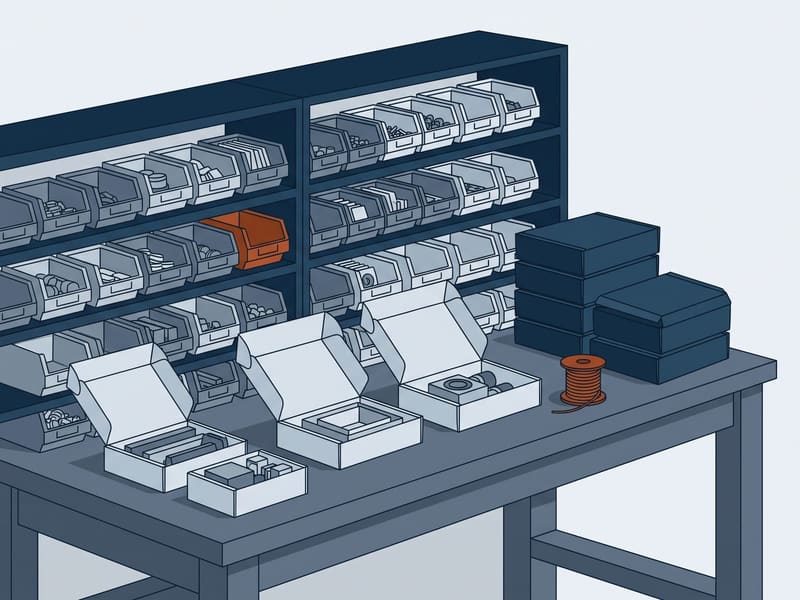
Co-packing, short for contract packaging, means paying another company to package a product you own: filling it, bundling it into multipacks, building store displays or relabeling it. We set out the service types, where a co-packing plant ends and a 3PL begins, how a run is set up, what a job costs, and how to choose a partner.
Quick summary
- Co-packing is contract packaging: an outside company packages a product the brand owns, from filling its first container to shrink-wrapping multipacks and building store displays.
- Jobs that handle exposed product need a plant built for that product, and food packers must register with the FDA, while secondary packaging on sealed goods is routine 3PL work.
- A co-packer packs the brand's product to the brand's spec, a co-manufacturer makes the product itself, and a private-label maker sells its own formula under the brand's name.
- Under GS1 rules a physically bundled multipack needs its own GTIN, and changing any item inside it means a new one.
- A co-packing quote has setup, per-unit labor, materials, pallet and storage lines, and our run of 8,000 club packs comes to $0.46 to $0.95 a pack.
- Choose a co-packer on product fit, capacity, materials ownership and lot records, and pay for a trial run before the full order.
What co-packing means
Co-packing is contract packaging: a brand pays an outside company, the co-packer, to package a product the brand owns. The brand sets the spec and usually supplies the product; the co-packer supplies the labor, the equipment and often the packaging materials.
The work covers 2 levels of packaging. Primary packaging is the first container the product touches: the bottle, pouch, can or jar. Secondary packaging is everything around sealed units: multipacks, shipping cases, shrink bundles and store displays. The level decides who can do the job.
Co-packing vs co-manufacturing vs private label
The 3 terms are often confused because one plant can do all 3 jobs. The difference is who owns the product and what the brand buys.
| Co-packing | Co-manufacturing | Private label | |
|---|---|---|---|
| Who owns the formula | The brand | The brand | The manufacturer |
| Who makes the product | The brand, or its manufacturer | The co-manufacturer | The manufacturer |
| Who packs it | The co-packer | The co-manufacturer, usually | The manufacturer |
| Whose name is on it | The brand’s | The brand’s | The brand’s |
| What the brand buys | A packaging service | Production, often with packing | A finished product |
Co-packing services
| Service | Examples | Level | Who can do it |
|---|---|---|---|
| Filling and sealing | Bottling a sauce, filling pouches, canning a drink | Primary | A plant built for the product |
| Case packing | Finished units into shipping cases to a retailer’s case pack | Secondary | Co-packer or 3PL |
| Multipacks and shrink bundles | Club 3-packs, variety packs, banded twin packs | Secondary | Co-packer or 3PL |
| Retail displays | Display-ready cases, counter trays, pallet displays | Secondary | Co-packer or 3PL |
| Labeling and relabeling | New barcodes, compliance labels, stickers over old copy | Secondary | Co-packer or 3PL |
| Kitting and assembly | Gift sets, sample kits, promotional packs | Secondary | Co-packer or 3PL |
| Repackaging | Bulk into retail units, a new pack size, a damaged outer box | Either | Depends on whether the product is exposed |
Most jobs brands bring to a co-packer are secondary: a retailer asks for a club pack, a promotion needs a display, or a label change means stickering 20,000 units already in stock. Gift sets sit where co-packing meets kitting work, and a 3PL may quote the same set either way, depending on whether it is built for its own customer orders or to a retailer’s case and display spec.
Which co-packing jobs a 3PL can do
The line between a co-packing plant and a 3PL is the product’s first seal. A job that opens the product, or puts it into its first container, needs a plant built for that product: a filling line, sanitation, quality testing and, for food, registration. The FDA requires facilities that manufacture, process, pack or hold food for consumption in the US to register, and to renew the registration every other year. Registration covers holding as well, so a 3PL that stores food may be registered already; registration alone does not make it a place to handle exposed product.
A job that works only on sealed, finished units is secondary packaging, the bench work many 3PLs sell as value-added services. Shrink-wrapping 3 sealed jars into a club pack, building a display-ready case, relabeling cartons with a new barcode and assembling a gift set from finished items all fall on this side of the line.
Marketplace sets fall there too. Amazon requires sets to carry a label such as “Sold as set” or “This is a set. Do not separate.”, and it stopped offering FBA prep and item labeling in its US store from 1 January 2026, so a set bound for FBA has to arrive built, bagged and labeled by the seller or a provider.
Co-packing and fulfillment are separate steps even under one roof. Co-packing builds the unit that sits on a shelf or in a pick location; pick and pack happens later, when an order pulls that unit and puts it in a shipping box. When the co-packing happens inside the 3PL that already handles the brand’s ecommerce fulfillment, finished packs go from the bench to a pick location with no freight leg in between.
Barcodes for multipacks and variety packs
A multipack is a new product in the barcode system. GS1’s rule for a predefined assortment treats a fixed set of items sold as one physical unit as a trade item with its own GTIN, while every item inside keeps its own. A variety pack that swaps one flavor is a different set, so it needs a different GTIN, and each case level above the pack needs one too.
Physical attachment is the test. GS1’s answer on multi-packs and bundles is that 3 jars shrink-wrapped together need a GTIN assigned by whoever creates the pack, while 3 loose jars sold together as an offer do not. For a co-packed club pack, that means the brand assigns the GTIN before the run and the packer prints it on the bundle label.
How a co-packing run works
- Write the spec: component SKUs and quantities, pack format, film or carton, label content and position, case count and pallet pattern.
- Quote and assign materials: who buys the film, cases and labels, and the spoilage allowance on each.
- Receive components: counted against the spec and held until the samples are approved.
- Run a trial: the packer builds samples, and the brand signs them off in writing.
- Run production: with in-line checks on count, seal and a scan of every bundle label.
- Record the lots: component lot numbers tied to the finished lot, so a recall can be traced both ways.
- Store or ship: finished goods go to storage, to the brand’s 3PL or straight to a retailer.
Stage 7 is where the retailer starts counting. Club packs and display shippers usually ship to a retailer’s distribution center, where a late or short delivery counts against the supplier’s on-time in-full score, so the run date has to sit far enough ahead of the ship date to absorb a failed sample or a late component.
What co-packing costs
Co-packing is priced per unit for labor, with setup, materials, pallet building and storage as their own lines, and usually a run minimum. Take 8,000 club packs of 3 units, shrink-wrapped with a new bundle label, packed 4 to a case and palletized for a retailer:
Co-packing beats an in-house line when the in-house line is costed in full: the floor space it takes all year, a supervisor, changeovers, scrap, downtime and the weeks it stands idle between promotions. A brand that runs 2 club-pack promotions a year seldom keeps a shrink tunnel busy enough to pack for less than a co-packer’s per-pack price.
How to choose a co-packer
Start with fit: a co-packer that already runs your format, shrink bundles or display cases or a filling line for your product type, has solved the problems your first run would otherwise discover. Then check the red flags that show up in the first meeting: vague answers on process control, no lot records to show, fuzzy ownership of materials and quality, no references or site visit on offer, and capacity promises that do not change with the season.
Frequently asked questions
What does co-packing mean?
Co-packing, short for contract packaging, means hiring another company to package a product you own. The work ranges from filling the product into its first container to building multipacks, retail displays and relabeled units. The brand keeps ownership of the product and sets the packaging spec.
What is the difference between co-packing and private labeling?
A co-packer packages a product the brand already owns, to the brand's spec. In private labeling, the manufacturer owns the formula and sells its own product under the brand's label. With private label the brand buys a finished product; with co-packing it buys a service.
How much does co-packing cost?
Co-packing is priced per unit for labor, plus setup, materials, pallet building, storage and often a run minimum. In our example, 8,000 shrink-wrapped club packs cost $3,710 to $7,620, or $0.46 to $0.95 a pack. Small reorders cost more per pack, because the minimum is spread over fewer units.
What is the co-packing process?
A run moves from a written spec to a quote, delivery of components, a trial run with signed-off samples, the production run, lot records, and storage or shipment of the finished goods. The trial run is the step not to skip, because it proves the label position, film and case count before the full run.
What is the difference between co-packing and co-manufacturing?
A co-packer packages a product that has already been made. A co-manufacturer makes the product itself, usually to the brand's formula, and often packs it as well. Food and beverage plants often do both, which is why the terms get mixed up.
Can a 3PL do co-packing?
Yes, for secondary packaging on sealed, finished goods: multipacks, variety packs, display-ready cases, relabeling and marketplace sets. Filling or portioning an exposed product is a job for a plant built for that product, and for food that plant must be registered with the FDA.
Does a multipack need its own barcode?
Yes, if the items are physically joined, for example shrink-wrapped: GS1 treats the pack as a new trade item with its own GTIN, and each item inside keeps its own. Changing any item in the pack means a new GTIN. Loose items sold together as an offer need no GTIN of their own.
What should a co-packing agreement cover?
It should cover the spec for each item, who buys and owns the materials, the spoilage allowance, sample approval and quality checks, lot records and lead times. It should also say who pays for components damaged in the packer's hands, where finished goods go, and who books the freight.