Ecommerce Fulfillment: Process, Models and Cost per Order
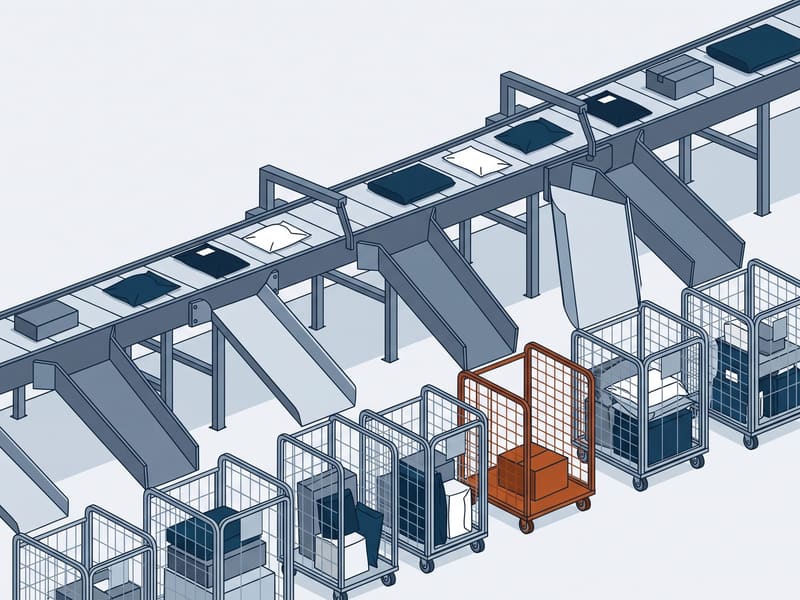
Ecommerce fulfillment is the work between a customer's checkout and a parcel on the doorstep: receiving stock, storing it, picking and packing each order, shipping it, and taking returns back. We set out the 5 steps, the ways brands run them, what a single order costs under each, and the service levels that show whether the operation is working.
Quick summary
- Ecommerce fulfillment runs in 5 steps: receive and store inventory, process the order, pick and pack it, ship it, and handle any return.
- A brand can fulfill in-house, through a 3PL, through Amazon's FBA for marketplace orders, or through a mix of these, while dropshipping hands the whole job to the supplier.
- Cost per order is the number to compare, because postage, packaging and a share of storage sit outside the pick and pack fee and usually add up to more than it.
- The service levels worth writing into a contract are the order cutoff, dock-to-stock time, on-time ship rate, pick accuracy and inventory accuracy, each with a number and a stated way to measure it.
- Outsourcing tends to pay once packing crowds out other work, peak season dwarfs the rest of the year, or customers sit too far from one building for 2-day ground delivery.
What ecommerce fulfillment is
Ecommerce fulfillment is everything that happens to an online order between checkout and the customer’s door, plus the trip back when a return arrives. It starts before the order, with inventory arriving at a building and being put where it can be found in seconds.
The volume behind it keeps rising. The Census Bureau’s quarterly retail survey put online sales at 17.1% of US retail sales in the second quarter of 2026, seasonally adjusted, against 16.3% a year earlier. Each percentage point of that share means more parcels to pick, pack and ship.
Three kinds of operator do the work: the brand itself, in its own space; a third-party logistics provider running a shared fulfillment center for many brands; and a marketplace, chiefly Amazon, fulfilling orders placed on its own site. Many brands use more than one.
The 5 steps of ecommerce fulfillment
Every order passes through the same 5 steps, whoever runs them. The gap between a smooth operation and a costly one shows up at the handoffs.
| Step | What happens | System of record | Where it breaks |
|---|---|---|---|
| 1. Receive and store | Inbound stock is counted, checked against the advance ship notice and put away | WMS | Cartons with no notice or mixed SKUs, counted by hand |
| 2. Process the order | The order is validated, routed to a building and released to the floor | Store platform, OMS | Payment holds, bad addresses, oversold stock |
| 3. Pick and pack | Items are picked, scanned against the order, boxed and labeled | WMS | Wrong item or quantity, oversized box |
| 4. Ship | A carrier and service are chosen and tracking posts back to the store | Shipping software | Missed carrier pickup, wrong service level |
| 5. Handle returns | Parcels come back, are inspected, then restocked or written off | WMS, returns portal | Returns left unprocessed for weeks |
Receiving and storage
Stock arrives on pallets or in cartons against an advance ship notice (ASN) listing SKUs and quantities. Receivers count and scan it, flag shortages and damage, and the WMS assigns each unit a location. The measure that matters here is dock-to-stock time, the hours until those units can be sold.
Freight already allocated to orders or to other buildings can skip storage by cross-docking the freight from the inbound door straight to an outbound trailer. For everything else, slotting decides walking time: fast sellers go near the pack stations, slow ones high up or at the back.
Order processing
When a customer places an order, the store sends it to the warehouse through an integration. Before release it is checked: payment captured, fraud screen passed, address validated, every line in stock. Any failure keeps it in awaiting fulfillment status until someone clears it, and that exception queue is where many late shipments begin.
With stock in more than one building, the order management system also routes each order, usually to the nearest building that holds every item. An order no single building can fill complete is either split into 2 parcels or held until stock arrives.
Picking and packing
Pickers collect the items, one order at a time or several in a batch, and each item is scanned against the order before it goes in the box. Most 3PLs bill pick and pack fees as a charge for the first item plus a smaller charge for each additional one, so units per order drive this line of the invoice.
Sets that sell together can leave the shelf as a single pre-built unit when the warehouse has done kitting ahead of demand, which turns a 4-item set into 1 pick and fixes the box size in advance. Packing adds the box or mailer, void fill, a packing slip and any inserts.
Shipping
Shipping software chooses the carrier and service for each parcel from its destination, weight, dimensions, promised delivery date and the rates on each account. Parcel carriers bill a light item in a large box on its size rather than its weight under dimensional weight pricing, so box choice at the pack station sets part of the postage.
Once the label prints, tracking posts back to the store and the customer gets a shipping email. The parcel still has to make the carrier’s pickup: an order packed after the last truck leaves ships a day later, whatever the email says.
Returns
Returns are the step brands plan least and pay the most for per unit. The National Retail Federation estimated that 19.3% of online sales would be returned in 2025, against 15.8% of all retail sales.
Each returned parcel enters the reverse logistics flow: received, inspected, then restocked, refurbished, sold off or written off under rules the brand sets. The rules matter more than the speed. A 3PL that restocks a worn item ships it to the next customer, who returns it too.
Ways to run ecommerce fulfillment
There are 5 models, and a brand selling on more than one channel usually runs 2 of them at once.
| Model | Who holds the stock | Who picks and packs | Cost structure | Suits |
|---|---|---|---|---|
| In-house | The brand | The brand’s staff | Rent, wages, equipment: mostly fixed | Low volume, custom or fragile products |
| 3PL | The 3PL’s building | The 3PL’s staff | Per order, unit and pallet: mostly variable | Growing brands on several channels |
| Amazon FBA | Amazon’s network | Amazon | Per-unit fees by weight and dimensions, plus storage | Amazon marketplace orders |
| Dropshipping | The supplier | The supplier | Supplier’s price per order | Wide ranges, little cash, little control |
| Hybrid or multi-node | Split across buildings or providers | Each operator | Mixed | National reach, several channels |
In-house fulfillment keeps control of packaging and quality and costs little at low volume. It gets expensive as volume grows, because the lease, staff and equipment are paid for whether orders come or not, and peak needs space the rest of the year leaves empty.
A 3PL turns those fixed costs into per-order fees and brings carrier rates negotiated across many clients. Beyond storage and shipping, many 3PLs assemble kits, take on retail-ready repacking and other co-packing jobs, and grade returns, each billed as its own line. The price is control: a problem arrives as a ticket rather than something you can walk over and fix.
Amazon’s FBA stores, picks, packs and ships orders placed on Amazon and handles customer service and returns for them. Fees are set per unit by weight and dimensions, storage is billed monthly on daily average cubic feet, and stock held more than 181 days draws an aged-inventory charge. Stock in Amazon’s network serves Amazon orders; it does not ship your own site’s orders in your own packaging.
Multi-node fulfillment splits one inventory across 2 or more buildings so each order ships from the one nearest the customer, cutting transit time and the zone on the label. A brand that starts on the West Coast usually adds an eastern building, and the choice tends to come down to the Northeast corridor, the Southeast around the Charlotte warehouse market, or a central hub, weighing rent and labor against the share of East Coast customers each puts within 2-day ground reach.
What ecommerce fulfillment costs per order
The pick and pack fee is the number brands compare first, and it is the wrong one. What a brand pays to fulfill an order is the sum of every line the order touches: labor, packaging, a share of receiving and storage, and postage. That total, cost per order, is the only figure that puts a 3PL quote, in-house fulfillment and FBA on the same scale.
Take 1 order of 2 units weighing 2 lb, packed in a small box and sent by ground to zone 5, from a pallet of 200 units that sells through in about a month.
The same order touches the same cost lines under the other models, billed in different ways:
| Cost line | In-house | 3PL | Amazon FBA |
|---|---|---|---|
| Pick and pack labor | Wages: about $1.43 an order at 15 orders an hour | Fee per order plus per additional item | Inside the per-unit fulfillment fee, set by weight and dimensions |
| Packaging | Bought in bulk by the brand | Per box or mailer, or included in the pick fee | Amazon’s packaging |
| Postage | The brand’s own carrier rates | The 3PL’s negotiated rates or the brand’s account | Inside the fulfillment fee |
| Storage | Rent, paid whether shelves are full or empty | Per pallet, shelf or bin per month | Per cubic foot of daily average volume, plus an aged-inventory charge past 181 days |
| Returns | Staff time | Per return processed | Handled by Amazon for FBA orders |
The in-house labor line comes from the Bureau of Labor Statistics, which puts the median for order fillers in the warehousing industry at $21.49 an hour in 2025. At 15 orders an hour through pick, pack and label, that is about $1.43 of wages per order before payroll taxes, benefits, supervision and the building itself.
In-house therefore looks cheapest per order on paper, and usually is at low volume, until the lease, equipment and software are divided by real order counts, slow months included. FBA folds pick, pack and postage for Amazon orders into one per-unit fee, so the fair comparison is against a 3PL’s total with postage, never against its pick fee alone.
Service levels for an ecommerce fulfillment operation
A fulfillment operation is working when orders leave on time, complete and correct, and stock that arrives becomes sellable quickly. Each of those can be measured, and each belongs in the service level agreement (SLA) with a number and a stated method.
| Measure | What it counts | How it is measured |
|---|---|---|
| Order cutoff | The latest order time that still ships the same business day | Order release time against the carrier’s first scan |
| Dock-to-stock time | Hours from a delivery’s arrival to units available to sell | Dock arrival against the inventory update in the WMS |
| On-time ship rate | Share of orders handed to the carrier by the promised time | Carrier’s first scan against the promised ship date |
| Pick accuracy | Share of orders shipped with the right items and quantities | Errors from pack scans, audits and customer claims, per 1,000 orders |
| Inventory accuracy | Share of locations where the system count matches the shelf | Cycle counts against WMS records |
Two things decide whether these numbers mean anything. The measurement has to come from a record neither side edits, such as the carrier’s first scan, and the SLA has to say what happens on a miss: a credit, a reship at the 3PL’s cost, or a right to exit.
The SLA protects the brand in law as well as in service. Under the FTC’s mail order rule, a seller is liable for shipping delays its fulfillment house causes, and FTC staff look at whether the seller contracted the fulfillment house to comply and monitored its shipping times. Wholesale orders add a second scorecard: big-box retailers grade suppliers on on-time in-full (OTIF) scores and many charge back for late or short deliveries, so a 3PL shipping B2B orders needs targets for those as well.
When to move ecommerce fulfillment to a 3PL
The case for a 3PL gets stronger with each of these:
- Packing has taken over someone’s job: the founder or ops lead spends afternoons on labels instead of buying, selling or fixing the product.
- Stock has outgrown the space: inventory is spread across a garage, a storage unit and a back room, and the counts drift.
- Peak dwarfs the rest of the year: when Q4 runs at 3 times the monthly average, holding space and staff all year for 6 weeks of peak costs more than per-order fees.
- Customers are far from the building: most parcels travel to the far zones, and 2-day ground delivery needs a second location.
- New channels bring new rules: marketplace, wholesale and retail orders arrive with labeling, routing and delivery-window requirements.
A 3PL is the wrong call when:
- Orders are a handful a day and cash is tied up in stock.
- Every order needs custom work, such as engraving, made-to-order assembly or hand packing of fragile goods, which 3PLs bill by the hour.
- Margins are thin enough that per-order fees and monthly minimums break the unit economics.
Choosing among providers then comes down to whether a 3PL’s buildings, systems and contract fit that order profile, not which one quotes the lowest pick fee. The timing of the move matters almost as much as the choice.
Frequently asked questions
What is ecommerce fulfillment?
Ecommerce fulfillment is the process of getting online orders from stored inventory to the customer: receiving stock, storing it, picking and packing each order, shipping it and handling returns. A brand can run it in its own space, hand it to a 3PL, or use a marketplace program such as Amazon's FBA.
When should I switch from in-house fulfillment to a 3PL?
Switch when packing takes time that should go to selling, when peak season needs space and staff you cannot carry all year, or when customers are too far from one building for 2-day ground delivery. Stay in-house if orders are few, need custom handling each time, or carry margins too thin for per-order fees. Work out your own cost per order both ways before deciding.
How much does ecommerce fulfillment cost per order?
In our worked example, a 2-unit, 2 lb order shipped by ground to zone 5 from a 3PL costs $12.05 to $16.65 all in. Postage is 63 to 66% of that, and the pick and pack lines are about 25%. Your own number depends on units per order, box size and how far customers are from the building.
What is hybrid fulfillment?
Hybrid fulfillment splits orders between 2 or more methods, such as FBA for Amazon orders and a 3PL for the brand's own site, or in-house packing for custom orders and a 3PL for the rest. It adds reach and a fallback when one operation has a bad week. The cost is inventory spread across several places that has to be balanced between them.
Can one fulfillment provider ship my Shopify and Amazon orders?
Yes, most ecommerce 3PLs connect to several storefronts and marketplaces and ship every channel's orders from one pool of stock. Check that each connection is native rather than a file upload, and that packing slips and inserts can differ by channel. Stock sent to Amazon's FBA network is separate and ships only from there.
How does fulfillment location affect delivery speed and shipping cost?
Carriers price ground parcels by zone, a measure of distance from the origin, so the same box costs more and takes longer the farther it travels. Splitting stock between 2 buildings lowers the average zone and transit time. The trade-off is more inventory to fund and balance.