Cross-Docking: How It Works, What It Costs, When It Fits
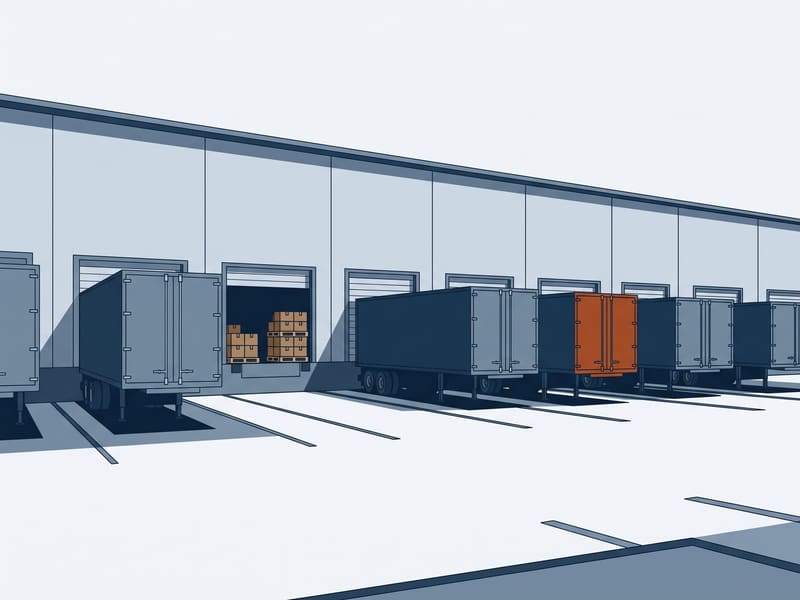
Cross-docking moves freight from an inbound trailer or container straight onto an outbound trailer, with little or no time in storage. It suits freight that already knows where it is going: it is sorted at the dock and leaves within hours rather than days. We explain how a cross-dock runs, its main types, what a brand must send before its freight arrives, how 3PLs price the work, and when storing wins.
Quick summary
- Cross-docking unloads inbound freight, sorts it by destination and loads it onto outbound trucks without putting it away in racking.
- Consolidation combines many small inbound shipments into full outbound loads, and deconsolidation splits one large inbound load across many destinations.
- It works only when every carton's destination is known before it arrives, which means an advance ship notice, the right labels and booked outbound appointments.
- 3PLs price cross-docking per container, pallet or carton handled, plus palletizing and relabeling, and bill storage once the freight overstays the free period.
- Storing the freight wins when inbound timing is unpredictable, when the stock is a buffer, or when the goods need inspection, kitting or a customs hold first.
What cross-docking is
Cross-docking is a dock-to-dock transfer. An inbound truck is unloaded, its freight is sorted by where it goes next, and it is loaded onto outbound trucks without being put away in racking. The building works as a sorting point, not a store.
The same idea runs at very different scales. Every LTL carrier terminal is a cross-dock: small shipments from many shippers are unloaded and regrouped onto trailers heading to the same region. Retailers run cross-docks that turn supplier truckloads into mixed loads for their stores. And many third-party logistics providers keep cross-dock doors in the same building as their storage, so one container can be split between the two.
| Cross-docking | Traditional warehousing | |
|---|---|---|
| Time in the building | Hours, until the next outbound truck | Days to months |
| Put-away and picking | None | Put away on receipt, picked per order |
| Known on arrival | The destination of every pallet or carton | SKU and quantity |
| Building layout | Many doors, open floor for staging lanes | Racking, pick faces, deep storage |
| Main cost | Handling per container, pallet or carton | Storage per pallet per month, plus handling |
| Suits | Freight with a known destination and a booked outbound slot | Buffer stock, slow sellers, order-by-order picking |
How a cross-dock runs, step by step
A cross-dock runs on appointments. Inbound and outbound trucks are booked against the building’s doors, and the whole flow depends on the freight’s destination being known before the truck backs in.
- Check in and assign a door. The inbound truck arrives on its appointment and goes to a receiving door close to the outbound doors its freight will leave from.
- Unload and scan. Pallets or cartons are scanned against the advance ship notice (ASN), and overs, shorts and damage are logged before the driver leaves.
- Sort by destination. Freight moves across the floor to the lane for its next stop. Mixed pallets are broken down and rebuilt as single-destination pallets, and cartons are relabeled where the receiver needs its own labels.
- Stage. Built pallets wait in the lane in front of their outbound door, in load order.
- Load and dispatch. The outbound truck is loaded on its own appointment, sealed and sent with a bill of lading for each stop.
The design constraint is the door count. A building with too few doors, or with every door booked for the same hours, cannot turn freight quickly, and freight left in staging becomes freight in storage.
Types of cross-docking
Cross-docks are described 2 ways: by when the destination is decided, and by what happens to the load.
| Type | What happens | Example |
|---|---|---|
| Pre-distribution | The destination is set before the supplier ships; cartons arrive labeled for their final stop | A supplier ships store-labeled cartons to a retailer’s cross-dock |
| Post-distribution | The destination is set at the dock, after the freight arrives | A distributor allocates a truckload across its branches once it is counted |
| Consolidation | Many small inbound loads are combined into full outbound loads | LTL shipments from 12 suppliers built into 1 truckload for a retail DC |
| Deconsolidation (break-bulk) | One large inbound load is split across many destinations | A 40-foot import container split between Amazon, a retailer and a 3PL |
Pre-distribution is faster and cheaper to run, since the dock only moves labeled freight to the right door. Post-distribution needs a decision on the floor, which takes time, labor and a WMS that knows the current orders. When the dock work also swaps the equipment, emptying an ocean container into a 53-foot domestic trailer for the trip inland, the job is transloading an import, and many port-side buildings do both.
Cross-docking an import container: a worked example
Deconsolidation is the case that matters most to a brand using a 3PL. A kitchenware brand imports a 40-foot container of 1,200 cartons across 4 SKUs. It lands at a West Coast port, travels inland by rail, and comes off the rail ramp on a short drayage move to a cross-dock near Chicago, where rail lines from both coasts meet the interstates. Comparing 3PLs around Chicago for this kind of job comes down to how far each dock sits from the ramps and how many doors it can turn in a day.
The container has 3 destinations, all decided before it sailed:
| Destination | Cartons | Built as | Labels |
|---|---|---|---|
| An Amazon fulfillment center | 480 | 12 pallets | Amazon carton and pallet labels |
| A retailer’s distribution center | 520 | 13 pallets | The retailer’s GS1-128 pallet label |
| The brand’s pick face at its 3PL | 200 | 5 pallets | The 3PL’s receiving labels |
The container is unloaded the morning it arrives, the pallets are built and labeled by the afternoon, and the 3 outbound trucks leave on their appointments the next day. The 5 pallets restock the brand’s ecommerce fulfillment operation that week instead of waiting behind a full container receipt, and the empty container heads back toward the ramp as soon as it is unloaded.
What makes that possible is information sent before the container arrives. Each retail pallet carries its own Serial Shipping Container Code, the GS1 number that identifies a logistic unit such as a case, pallet or parcel, and the retailer matches that number to the ship notice it receives before the truck.
The split is the part that has to be written out in full:
What cross-docking costs
No public market rate exists for cross-docking; each operator quotes it from its own rate card, often per load or per program rather than under a long-term contract. The lines repeat: an unload charge per container, trailer or pallet; palletizing and wrapping when freight arrives floor-loaded; relabeling per carton or pallet; outbound loading; and a free period, after which the freight is billed as storage.
Carrier detention for an outbound truck kept waiting because the freight was not ready usually lands on the shipper as well. Get the cross-dock rates and the free period in writing next to the storage rates, since both belong on the same sheet when comparing 3PL bids against a real month of freight.
Stored instead, the same 30 pallets would add put-away and at least a month of storage before a second round of handling out. On freight that already has a destination, that difference is the whole case for cross-docking, and it is lost the moment freight arrives without one.
When cross-docking fits and when storing wins
Cross-docking fits when:
- The destination is known before the freight ships. Retail replenishment against POs, Amazon inbound shipments and store orders arrive already allocated.
- The same lanes repeat. Weekly containers from the same supplier to the same DCs let the dock build a routine and hold standing appointments.
- The freight is time-sensitive. Perishables, promotional stock with a launch date and retail orders with a delivery window gain the most from skipping storage.
- Small shipments can be combined. Several suppliers’ LTL freight consolidated into 1 truckload to the same receiver costs less than each shipping separately.
- Speed saves a storage cycle. Stock that would be received, stored for a week and picked again as full pallets is cheaper moved once.
Storing wins when:
- Inbound timing is unpredictable, or the orders arrive after the freight does.
- The stock is a buffer against demand, not a delivery.
- The goods need inspection, kitting, unit-level relabeling or a quality hold first.
- The goods are held for a customs exam, or the importer wants to keep them in bonded warehouse storage with the duty unpaid.
Frequently asked questions
What does "received at crossdock" mean?
It means your shipment has reached a carrier terminal where it is unloaded from one trailer and sorted onto another heading toward its destination. It is a normal step for LTL freight and many parcel networks, not a delay by itself. The next scan usually shows it leaving on the outbound trailer.
How much does it cost to cross-dock?
There is no single rate: 3PLs bill an unload charge per container, trailer or pallet, plus palletizing, relabeling and outbound loading, and storage once the free period runs out. In our example, a floor-loaded 40-foot container split across 3 destinations costs $970 to $1,910 in handling, or $32 to $64 per pallet shipped.
Is cross-docking profitable?
For the operator, only with steady volume on both sides of the dock. A cross-dock earns per unit handled and has no storage income, so idle doors and crews cost money. For the shipper, it pays when it removes a storage cycle and a second round of handling.
What companies use cross-docking?
LTL carriers, parcel networks, big-box retailers and grocery chains run cross-docks at the center of their networks, and many 3PLs offer it next to storage. Brands use it most for retail replenishment and Amazon inbound shipments, where the destination of every carton is set before it ships.
Does Walmart cross dock?
Yes. Walmart is the retailer most often used as the example of cross-docking. Supplier freight arrives at its distribution centers, and freight bound for stores can move onto outbound trucks without going into storage.
How long does freight stay at a cross dock?
Usually hours rather than days, since it leaves on the next outbound truck to its destination. Operators set a free period in the rate card and bill storage after it, so the length of that period is the number to ask for.
What is the difference between cross-docking and transloading?
Both move freight from inbound equipment to outbound equipment without storing it. Transloading also changes the type of equipment, most often from an ocean container to a 53-foot domestic trailer near a port. Cross-docking usually moves freight between trucks of the same kind and centers on sorting by destination.
Is cross-docking cheaper than warehousing?
Per pallet it usually is, because it removes put-away, monthly storage and a second pick. It stops being cheaper when freight arrives without a destination, since that freight is received and stored anyway and the cross-dock handling is paid on top.