Pick and Pack Fulfillment: Methods, Accuracy and 3PL Fees
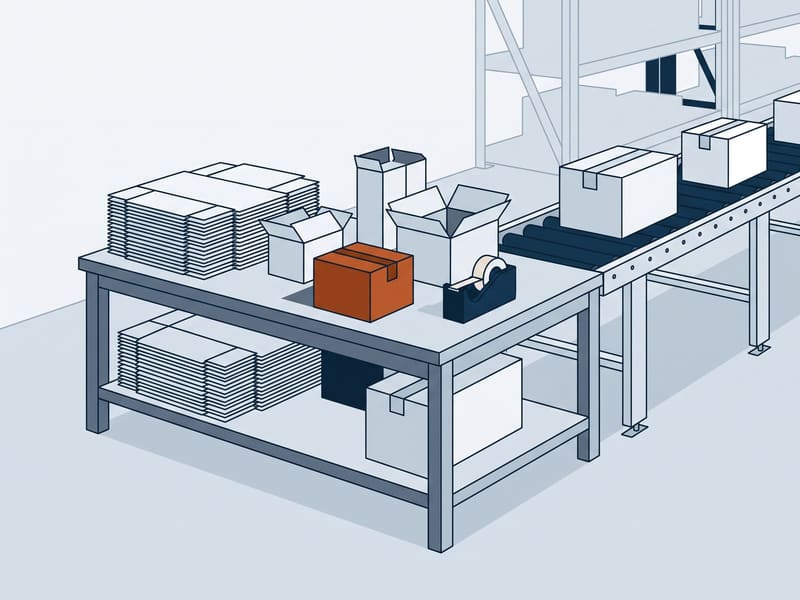
Pick and pack is the part of fulfillment where items come off the shelf and leave as a sealed, labeled parcel. It is the step customers judge a warehouse by, because it decides whether the right things arrive in the right box. We set out the process, the 5 picking methods and when each fits, how packing sets postage, how 3PLs bill for the work, and how to hold them to an accuracy number.
Quick summary
- Pick and pack is the step inside fulfillment where the items for an order are collected from storage, checked, packed with a packing slip and labeled for the carrier.
- Warehouses pick in 5 main ways, 1 order at a time, in batches, by zone, in timed waves or in bulk for identical orders, and busy buildings combine 2 or more.
- 3PLs usually bill a fee for the first item in an order plus a smaller fee for each additional item, with boxes, inserts and special packing charged separately.
- Box choice sets part of the postage, because parcel carriers bill a light item in a large box on its size rather than its weight.
- Accuracy belongs in the contract as a measured rate, with named scan points, a credit per error and the 3PL paying for the reship.
What pick and pack means
Pick and pack is the work of turning an order into a parcel: collecting each item from its storage location, checking it against the order, packing it with protection, a packing slip and any inserts, and labeling the box for the carrier. It is the third of the 5 steps of ecommerce fulfillment, after receiving stock and processing the order, and before shipping and returns.
“Pick, pack and ship” is the same process with the carrier handoff included, and it is how many 3PLs name their core outbound service.
The work is done by 2 of the occupations the Bureau of Labor Statistics tracks. Stockers and order fillers receive and track merchandise and prepare customer orders; hand packers and packagers package products by hand, including labeling and inspecting them. Both sit in a wider group of hand laborers and material movers that held 6,917,800 jobs in 2025. Their median pay in May 2025 was $37,330 a year for stockers and order fillers and $36,280 for hand packers, and their time is most of what a pick and pack fee pays for.
The pick and pack process, step by step
| Step | What happens | Check point | Common error |
|---|---|---|---|
| 1. Order intake | The order arrives from the store or marketplace | Integration passes every field | Manual entry typos, orders never imported |
| 2. Release | The WMS groups orders and builds pick lists | Stock allocated to every line | Orders released after the last useful wave |
| 3. Pick | Picker goes to each location and takes the quantity | Scan of the location and the item | Look-alike SKU, wrong quantity |
| 4. Verify | Each item is scanned against the order at the bench | Scan match, weight check | Scan skipped on “easy” orders |
| 5. Pack | Box chosen, items packed with void fill, slip and inserts | Box size against the spec | Oversized box, missing insert |
| 6. Label | Carrier and service chosen, label printed, tracking sent | Service matches the order’s promise | Ground label on an expedited order |
| 7. Hand off | Parcels staged by carrier and scanned at pickup | Carrier’s first scan | Parcel misses the truck |
Order intake decides how much can go wrong later. A native connector or API pushes each order to the warehouse within minutes with every field intact; a daily file upload or manual entry adds a delay and a chance to mistype an address or a quantity.
Printing the label is what changes the order to fulfilled on most store platforms, which is why order fulfillment statuses can show an order as fulfilled hours before a carrier has touched it. The carrier’s first scan, at step 7, is the only proof the parcel has left.
Wholesale orders run the same 7 steps with bigger units. Pickers take full cases or pallets rather than single items, each carton gets a label and a packing list to the retailer’s spec, and the retailer’s routing guide sets how cartons are labeled, stacked and booked. A miss on any of those usually comes back as a chargeback rather than a customer email.
Picking methods and when each fits
| Method | How it works | Fits | What it costs |
|---|---|---|---|
| Piece (discrete) picking | 1 picker takes 1 order from start to finish | Low volume, large items, complex orders | The most walking per order |
| Batch picking | 1 picker collects items for 10 to 30 orders in one trip | Many small orders sharing SKUs | A sort step at the bench, and sort errors |
| Zone picking | Each picker covers one area; orders move between zones | Large buildings, thousands of SKUs | A bottleneck when one zone is busier than the rest |
| Wave picking | Orders released in timed groups matched to carrier pickups | High volume with fixed cutoffs | WMS wave planning, and idle time between waves |
| Bulk picking | A full case or pallet of 1 SKU picked for many identical orders | Launches, preorders, subscription drops | Works only when orders are identical |
Busy buildings combine them. A common setup filters single-unit orders out first and bulk picks them to a pack line, where each unit goes straight into its mailer. Multi-unit orders are batch picked onto carts carrying pre-built boxes with the labels already printed, so the picker drops each item straight into its shipping box. That second pattern only works when the WMS has chosen each box before the pick starts.
Which method your orders get depends on their shape more than their count. A brand whose orders are 80% single units, all from 20 SKUs, is cheap to pick in bulk. A brand with 3,000 SKUs and orders averaging 4 units needs zone or batch picking, and its per-order cost will be higher at any 3PL, because each order means more stops.
The method can also change with the season. A building that picks orders one at a time most of the year often switches to waves and batches in November, staffed partly by temporary workers who have had a day or 2 on the scanners, which is exactly when scan discipline matters most.
Packing: box choice, cartonization and postage
Packing protects the product and sets part of the postage. Parcel carriers bill a parcel on the greater of its actual weight and its dimensional weight, a figure calculated from the box’s length, width and height, so a 1 lb item in a box built for 5 lb pays for the air around it.
Cartonization is the WMS choosing the box for each order before or during the pick. It works from each item’s dimensions and weight, fragility, the carrier’s size rules and the set of boxes on hand, and picks the smallest one that fits safely. It is only as good as the SKU data behind it: a product entered as 4 x 4 x 4 inches that is really 6 x 6 x 4 gets a box it does not fit, and a packer who reaches for the next size up every time.
Sets that always sell together are faster to handle when they are kitted in advance: 1 pre-built unit, 1 pick, and a box size fixed ahead of time.
| Order shape | Usual packaging | Why |
|---|---|---|
| 1 soft item (apparel) | Poly mailer | Lightest option, no void fill |
| 1 small rigid item | Padded mailer or small box | Protection without dimensional-weight waste |
| 2 to 4 mixed items | Right-sized box with paper fill | Stops items shifting and breaking |
| Fragile item | Box-in-box or molded insert | Survives drops in the carrier network |
| High-value item | Plain outer box, no branding | Less attention in transit |
Marketplace orders add a rule of their own: the packing slip and inserts often have to be neutral, without the brand’s own site promotions, so a 3PL has to vary what goes in the box by channel.
How 3PLs charge for pick and pack
3PLs price pick and pack in 4 ways, and the same orders can cost very different amounts under each:
| Structure | How it is billed | Suits | Watch for |
|---|---|---|---|
| Per order plus per additional item | A fee for the first item, a smaller fee for each extra unit | Most direct-to-consumer brands | Orders with many units |
| Per unit picked | The same fee for every unit | Mostly single-unit orders | Multi-unit orders cost a multiple |
| Flat per order | One rate per order, sometimes with the box included | Simple budgeting | Small orders paying for large ones |
| Hourly | Labor minutes at a set rate | Special projects, custom packing | No ceiling on the bill |
The per-order-plus-per-item model is the most common for ecommerce, and it is why order shape drives the bill. Take a brand shipping 2,000 orders in a month: 70% are single units and 30% average 3 units, so 600 orders carry 1,200 additional items.
Other charges often sit outside the pick and pack lines: a monthly minimum at some providers, special packing such as gift wrap or hand-folded tissue billed by the hour, and peak surcharges in November and December. Ask for all 3 in writing with the rate card.
Pick and pack accuracy: scans, counts and contract terms
A wrong item is caught, or not, at 3 points:
- At the shelf: the picker scans the location and the item, so a look-alike SKU in the next bin is refused before it goes in the tote.
- At the bench: each item is scanned again against the order, which catches wrong quantities and items that were picked for the wrong order in a batch.
- At the scale: the sealed parcel is weighed against the expected weight of its contents, which catches a missing or extra unit the scans missed.
Accuracy is quoted as a percentage or as errors per 1,000 orders. They are the same figure, but the second makes small changes visible:
| Accuracy | Errors per 1,000 orders | Errors in a 5,000-order month |
|---|---|---|
| 99.0% | 10 | 50 |
| 99.5% | 5 | 25 |
| 99.8% | 2 | 10 |
| 99.9% | 1 | 5 |
Customer complaints undercount errors. A customer sent the wrong color usually writes in; one sent an extra unit often does not, so a 3PL measuring accuracy only from claims reports a better number than it earns. The count should combine pack-station exceptions, the 3PL’s own audits and customer claims.
Speed belongs in the same clause as accuracy, because a building can buy accuracy with time. The useful measure runs from order release to the carrier’s first scan, with a same-day promise for every order released before the cutoff.
Automation in pick and pack
Most 3PL buildings still pick by hand with handheld scanners. Automation changes the numbers a brand sees (speed, parcel size, peak capacity) more than the process itself:
| Technology | What it does | What it changes for a brand |
|---|---|---|
| Handheld RF scanners | Direct the picker and confirm each scan | The baseline for scan-verified accuracy |
| Pick-to-light and put walls | Lights show which bin to pick from or which order slot to fill | Faster batch sorting, fewer sort errors |
| Autonomous mobile robots | Carts that follow pickers or carry totes to the pack area | Less walking, steadier output at peak |
| Goods-to-person systems | Robots bring storage bins to a fixed picking station | Dense storage, fast picking of small items |
| Auto-baggers and box-on-demand machines | Seal items in a mailer or build a box to fit | Smaller parcels, lower dimensional-weight postage |
RFID tags can be read many at a time without line of sight, which suits apparel and high-value goods, but every unit needs a tag that costs money, so barcodes remain the default.
Automation earns its keep on volume and item size. A goods-to-person system suits a 3PL moving millions of small, fast-selling units and adds little for a brand shipping bulky furniture. When a 3PL leads with its robots, ask which of them your orders would actually touch.
Pick and pack software and layout
Running pick and pack in-house, the tool sets the ceiling:
- Store-native order tools print labels and packing slips but know nothing about locations, so pickers work from memory.
- Inventory apps track counts across channels and can print pick lists, but rarely support scanning at the shelf.
- A warehouse management system (WMS) holds every location, builds pick paths and batches, enforces scans and chooses boxes; it is what 3PLs run their floors on.
- An ERP covers purchasing and accounts, and usually needs a WMS beside it for the floor.
Layout matters as much as software. Fast sellers belong near the pack stations at waist height, slow ones high up or at the back, and every location needs a clear label that matches the system. A layout set up at launch drifts as the range changes, so it needs a review whenever the top 20 SKUs change.
Outsource pick and pack or keep it in-house
A 3PL’s pick and pack fits best when:
- Order volume swings: a 3PL moves staff between clients, so peak weeks do not need a hiring round.
- Orders come from several channels: marketplace, site and wholesale orders run through one pick process with channel-specific slips.
- Products need tracking: lot numbers, expiry dates and serial numbers are captured by a WMS far more reliably than by hand.
- Labor is the bottleneck: the team spends its day packing instead of selling.
It fits badly when every order is custom-built or personalized, when products are so fragile each one needs a practiced hand, or when volume is a few orders a day and the monthly minimum outweighs the work.
Frequently asked questions
What does pick and pack mean?
Pick and pack means collecting the items for a customer's order from warehouse shelves and packing them into a shipping box with a packing slip and label. It is the middle of fulfillment, after the order is received and before the carrier collects the parcel.
What does a pick and packer do?
A pick and packer works the aisles collecting items from a pick list or handheld scanner, then packs them at a bench with void fill, inserts and a label. Most of the shift is walking, scanning and lifting, with the warehouse system counting picks per hour.
How much does a picker packer make?
The Bureau of Labor Statistics put the median wage for stockers and order fillers at $37,330 a year in May 2025, and for hand packers and packagers at $36,280. Order fillers working in the warehousing and storage industry earned a median of $21.49 an hour in 2025.
Is pick packing a hard job?
It is physically demanding rather than complicated. A shift means hours of standing and walking, repeated lifting and bending, and pick-rate targets tracked by the warehouse system, with overtime common in the holiday peak. Most people learn the process itself within a few days.
What is the difference between pick and pack and fulfillment?
Pick and pack is one step inside fulfillment. Fulfillment also covers receiving and storing stock, processing the order, shipping it and handling returns.
What does pick, pack and ship mean?
It is the same process with the carrier handoff added: items are picked, packed and labeled, then handed to a carrier, usually the same day. Many 3PLs sell the 3 together as their core outbound service, with postage billed separately or folded into a per-order rate.
How do 3PLs charge for pick and pack?
Most charge a fee for the first item in each order plus a smaller fee for each additional item, with boxes and inserts billed per unit. Some charge a flat rate per order or the same fee for every unit picked, and special packing is usually billed by the hour. Compare quotes by running last month's orders through each rate card.
Should a 3PL use batch, zone or wave picking for my orders?
It depends on your order shape more than your volume. Mostly single-unit orders from a small range suit bulk or batch picking, many SKUs with multi-unit orders suit zone picking, and high volume against fixed carrier cutoffs suits waves. Most busy 3PLs combine methods, so ask how your own orders would be split between them.
What is cartonization?
Cartonization is the warehouse system choosing the box for each order from the dimensions and weights of its items. It picks the smallest box that fits safely, which saves packing material and dimensional-weight postage. It only works when every SKU's dimensions are recorded accurately.