Kitting in Fulfillment: Process, Kit SKUs and Kitting Fees
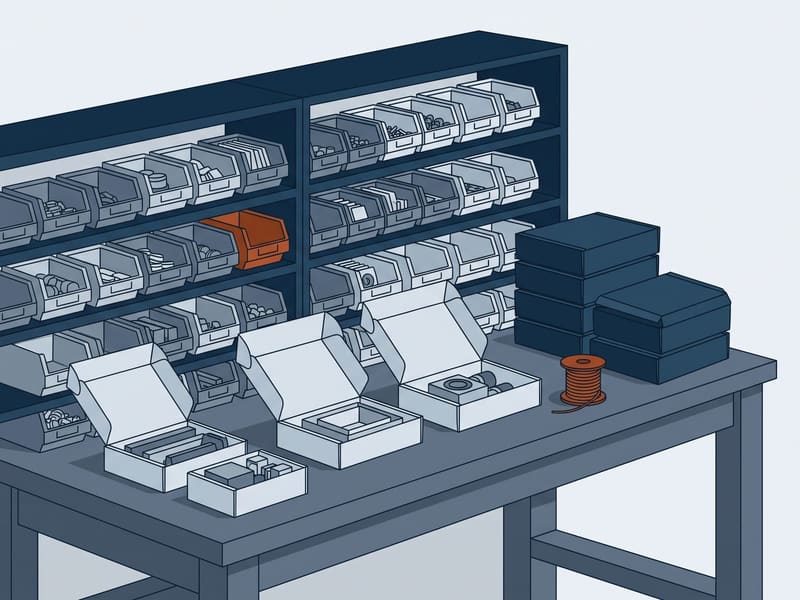
Kitting is the assembly of separate items into one unit that is stored, sold and shipped as a single product: a gift set, a starter kit, a subscription box. In a warehouse it turns several picks into one. We explain how kitting runs, when to build kits ahead and when to build them per order, how kit SKUs and barcodes work, and what a 3PL charges for the labor.
Quick summary
- Kitting combines 2 or more separate SKUs into 1 unit with its own SKU, which is then stored, picked and shipped as a single item.
- Pre-kitting builds sets ahead of demand and suits steady sellers, while on-demand kitting builds each set when its order arrives and suits unpredictable ones.
- Under GS1 rules a physically bundled kit needs its own GTIN, each component keeps its own, and changing any component means a new GTIN.
- A kit is only in stock when every component is, so inventory has to be tracked at the component level as well as the finished kit.
- 3PLs bill kitting per finished kit or by the labor hour, plus a setup fee, materials and storage of the finished sets.
What kitting means
Kitting is assembling 2 or more separate items into a single unit that is stored, sold and shipped as one product. A skincare starter set, a coffee gift box, a first-aid kit and a monthly subscription box are all kits. The finished kit usually gets its own SKU, so the warehouse picks 1 unit where it would otherwise pick 4 or 5.
The word has a second, older meaning in manufacturing. Job kitting, or line kitting, stages every part a work order needs in one tote or cart before assembly begins, so the assembler never walks to the stockroom mid-job. Full kitting takes that to the limit: every component for one finished product in one kit, common in electronics and medical device assembly. The rest of this guide is about the fulfillment kind.
Kitting vs bundling
The 2 words are often used interchangeably, but the difference matters in the warehouse:
| Kit | Bundle | |
|---|---|---|
| Assembled | Before the order, or at the order as a set task | Not assembled; items packed together at the order |
| SKU | Its own kit SKU, with a component list behind it | Items keep their own SKUs |
| Stored as | Finished units | Separate items |
| Picked as | 1 unit | Each item separately |
| Barcode | Its own GTIN if the items are physically joined | None of its own if the items are loose |
Our working rule: if it has its own SKU and exists as a physical unit before it is picked, it is a kit. If it is a price offer on items that stay separate until the box is packed, it is a bundle. Platforms and 3PLs blur the line, so any quote or integration should say which one it means.
When kitting pays
Kitting earns its cost in 5 common cases:
- Items that almost always sell together: a razor and its first pack of blades, a camera and its strap.
- Gift sets and seasonal promotions: fixed sets sold for a few weeks at high volume.
- Subscription boxes: the same contents going to thousands of subscribers on one ship date.
- Starter and refill kits: a fixed first purchase that brings customers back for refills.
- Clearing slow stock: a slow seller paired with a best seller moves at a better price than a discount.
It does not pay for sets that sell a few units a month, combinations that change every week, or components that also sell on their own and are always short, because every unit locked inside a finished kit is a unit that cannot ship alone.
The warehouse savings are concrete. A 4-item set picked loose is billed as 1 order with 3 additional items under the per-item pick and pack fee, or $1.50 to $2.25 in extra-item fees at $0.50 to $0.75 an item; built in advance it is 1 item. A fixed kit also has a fixed weight and box size, so its label can be printed before the orders arrive and its box can be sized to cut dimensional-weight postage.
Pre-kitting vs on-demand kitting
| Pre-kitting | On-demand kitting | |
|---|---|---|
| When kits are built | In a batch, ahead of demand | When each order arrives |
| Storage | Finished kits, usually denser than loose parts | Loose components |
| Labor timing | Scheduled before the peak | Added to every order at the peak |
| Risk | Kits built for demand that never comes | Slower picking and packing per order |
| Fits | Steady sellers, promotions with a known ship date | New or unpredictable sets, personalized sets |
Many brands run both: a pre-built batch sized to the forecast, with on-demand kitting covering any demand above it.
How the kitting process works
- Write the bill of materials: every component SKU and quantity, the packaging, the inserts, the order the items go in and the label.
- Create the kit SKU, and a GTIN if the kit will be sold as a physical bundle.
- Receive and count the components, and confirm there are enough of every one for the run.
- Build: components are picked to a kitting bench, assembled in the set order, packed and sealed.
- Check and label: every kit is weighed and labeled with the kit barcode, and a sample is opened and checked against the bill of materials.
- Put away: finished kits go to their own location, and the WMS removes the components and adds the kits.
- Ship: each kit is picked as 1 unit, like any other SKU.
Work that changes the product’s own retail packaging, such as shrink-wrapping multipacks for a store or building display shippers, crosses into co-packing work, which many 3PLs quote separately from kitting.
Kit SKUs, barcodes and inventory
A kit’s barcode follows GS1 rules. Under the GS1 GTIN Management Standard, a predefined assortment, a fixed set of 2 or more items sold as a single physical unit, gets a GTIN of its own; each item inside keeps its own GTIN; and changing, adding or replacing any item in the set means a new GTIN. GS1’s example is a perfume 3-pack with one scent swapped: a new set, so a new number. Each packaging level above the consumer unit, such as a case of 6 kits, needs its own GTIN as well.
Whether a set needs a GTIN at all depends on how it is put together. GS1’s guidance on multi-packs and bundles says a bundle whose items are physically attached, shrink-wrapped or banded together for example, needs its own GTIN assigned by whoever creates it. A virtual bundle of loose items does not, and a bundle defined by the manufacturer already has a GTIN that must be used.
Inventory works at 2 levels. A kit is only in stock when every component is, so the number of kits a brand can sell is set by its scarcest component. With 1,400 candles, 900 matchboxes, 2,000 cards and 1,100 gift boxes on hand, the brand can build 900 gift sets, whatever the candle count suggests. The WMS has to track both the finished kits and the components still loose, and the store has to list only what can actually be built or has been.
What a 3PL charges for kitting
3PLs price kitting per finished kit, usually scaled by the number of components and steps, or by the labor hour for complex or one-off jobs. Most jobs also carry a setup fee for the work order and the bench, materials the brand does not supply, and storage for the finished kits. Take 1,200 gift sets of 4 components, pre-kitted before the holidays, with the gift boxes supplied by the brand:
Set against the pick fees it removes, the assembly charge rarely costs extra. At these rates the assembly fee is never more than the 3 additional-item fees a loose 4-item set would carry, before counting the smaller box and the faster pack.
Kitting in-house or with a 3PL
Kitting in-house makes sense for small runs, for sets that need a practiced hand, such as hand-tied ribbon or personalized cards, and for sets that change too often to write a work order for each. Its costs are easy to underestimate: a bench plus staging space for components and finished kits, staff pulled off picking in the weeks the kits are built, and a second person checking samples, since a kit missing 1 component looks complete until the customer opens it.
A 3PL makes more sense for large seasonal runs, when the labor and floor space are needed for a few weeks rather than all year, and when the kits ship from the same building as the rest of the range. There, kitting is priced the way the rest of ecommerce fulfillment at a 3PL is, per unit of work with setup and materials itemized. Finished kits also go from the bench straight to their pick locations, with no freight leg between a packaging supplier and the warehouse.
Frequently asked questions
What do you mean by kitting?
Kitting means assembling separate items into one unit that is sold and shipped as a single product, such as a gift set or a starter kit. The finished kit usually gets its own SKU and is picked as one item. In manufacturing, the word means gathering all the parts a job needs before assembly starts.
What is job kitting?
Job kitting is the manufacturing sense of the word: staging every part and consumable a work order needs in one container before the job reaches the line. It saves assemblers from walking to stores mid-job, and a missing part is found before work starts rather than halfway through.
How does kitting work in retail?
A retailer or brand defines a set, such as a candle, matches and a card in a gift box, and gives it its own SKU and listing. A warehouse assembles the sets ahead of demand or as orders arrive, and each finished set is stored, picked and shipped as one unit.
What is a kitting fee?
A kitting fee is what a 3PL charges to assemble kits, billed per finished kit by component count or by the labor hour. Most jobs also carry a setup fee, materials such as shrink wrap and labels, and storage for the finished kits. In our worked example, 1,200 gift sets of 4 components cost $0.96 to $2.33 per kit before the gift box itself.
What is kitting and fulfillment?
It describes a 3PL service that assembles kits and then ships them to customers, so the brand sends in components and customers receive finished sets. The kitting happens in the same building as storage and pick and pack, which saves a trip between a packaging supplier and the warehouse.
What is the difference between kitting and bundling?
A kit is assembled before the order and has its own SKU, so it is stored and picked as one unit. A bundle is usually an offer, such as buy 2 and save, whose items keep their own SKUs and are picked separately. The words are often used loosely, so check which one a 3PL or platform means.
Does a kit need its own barcode?
It does if the items are physically joined and sold as one unit: GS1 says a physical bundle needs its own GTIN, assigned by whoever creates it. A virtual bundle of loose items does not, and every component keeps its own GTIN either way. A bundle defined by the manufacturer already has a GTIN, which you must use.